Tuesday, November 8, 2011

Learner Journals ...2.

Your Journal

Your Journal is a distillation of all the new things you learn each day.  You list a maximum of three things.  Each one needs an example of how you learned to use it.  These need to be personal examples which are true from your life.  You can note grammar, pronunciation or vocabulary.  Every few days hand it in to me for review.  I will read through it and clearly point out any mistakes or errors.

How to start--

Put your name on the front and the level and room.

Use the inside cover as a record of any words which are difficult to spell.

Date, Time, Day and Teacher for each lesson's page.

Do's and Don't's
  • Don't use this as a notebook.
  • Don't write lists of new words. Remember only three things per lesson.  It is not supposed to be everything.  Everything goes in your notebook.  This is three favorites.  
  • Do write good examples of new words in use.
  • Do note things which were not the main point of the day.
  • Do write about new things only.  
  • Don't note things you learned in other lessons.  Focus on what you got out of that experience.
  • Do be specific.
  • Do give real life examples.
  • Don't write: "will and going to for future" because you already knew that.
  • Don't write: "going to is for future plans" because it's not specific
  • Do write: "'(be) going to go to' is used interchangeably with '(be) going to'" 
  • Don't write: "We are going to go to the park." as an example.
  • Do write: For example "We are going to Phoenix Park with Ciara and Oisin, the CES staff, this weekend." =   "We are going to go to Phoenix Park with Ciara and Oisin, the CES staff, this weekend."  


This shows your understanding and is specific enough for me to understand that this is an example from your real life.  It is most important to be able to talk about things you know you.  They are what you will talk about most often.  Write about what you know, what you are learning and what you do.

Use one page for me and one page for Bayveen.  These journals cost about 22 cents each.  Use them up and buy yourself a present when you get to the end of each one.  A coffee costs about the same as ten of them.  So go nuts.

If you can't find three new things from your notes, the pages or the homework, it's good feedback for me.  If you aren't getting anything new out of the lessons, this is how I will find out. 

The last pages of the notebook can be used as writing space for homework and classroom assignments. 

Good luck.  (And when you get back to your home country you can look over this journal and sell it to a local publisher.  Send us a Christmas card when you are rich and famous.)

Friday, November 4, 2011

A weak week.

This is pretty lame.  I am letting the blog slip as I start catching up on my dissertation.  It is rather important.

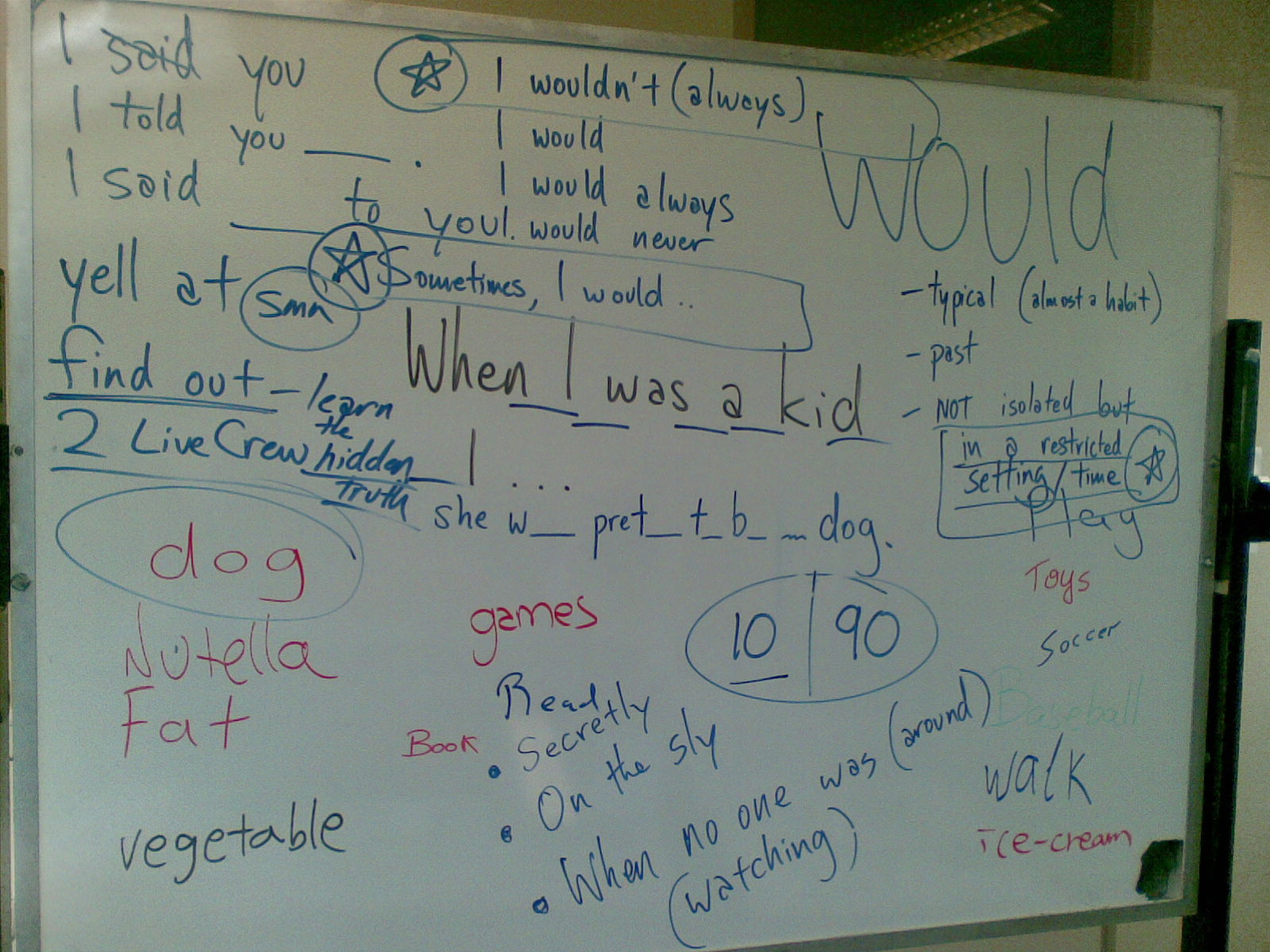
The least I could have done was post the whiteboard shots.  So here you are.


Wednesday, October 26, 2011

Wednesday, Wednesday

There will always be accuracy problems if you are communicating fast but I want you to reduce them as much as possible.  Verb tense errors are errors which seem easy to fix but early elementary mistakes can carry on until Upper-Intermediate.  How did we fix these errors and what did you learn.?

I go one minute to the toilet


Where have you been?
                                            I have a headache.


What I think it will happen didn't happen.


ACCURACY IS STILL IMPORTANT... if you want to be more than a worker.  If you want to be a leader you have to do more than survive in English.  You have to try to be excellent.

-We learned about future tenses.

-We tried reducing the words in the phrase "I'm going to make a pizza"

-We explored using noun phases with question words at their heads like the "what you want" the classic Rolling Stones song "You can't always get what you want."
 

You also did your writing project on the books which you need to finish for Friday. Good luck.


Monday, October 24, 2011

Monday, Monday

As usual we had new people in class today.  With Massi, Khalid and Michelle gone it was like an entire new group.

So today we started with "Graded Readers" (aka books) and Learner Journals (see photo below).


In the Learner Journals, everyone will be writing down what they got from today's lesson.  I admit today was a mess.  It was a mess because although there was a plan, it was NOT carried out because of all the new people who hadn't been studying with us over the last week.

But I think we can learn a lot from messes.  What did we learn about today?

  • The difference between "Have you heard of_________?" and "Do you know_______?" for people, food and places.
  • How and when to ask "For how long?" and "Since when?"
  • We learned that "since" can be followed by a subject + verb in the past simple
  • We learned about ENGVID.COM and how that is the place for general questions
And there was more but for now I'll wait to see the learner journals for more detail.  Let's hope there's lots there.  What did you learn in class today?


Thursday, October 20, 2011

Spending time on Dmitry's homework and a little work from the book.

About six of the extra large class we had yesterday returned with completed homework from yesterday.  

One of them- our favourite Russian- had written his homework into his notebook.  So I had to check his work in class and we found an interesting sentence with three little issues.  His actual sentence had just one problem, but all of the learners worked together in little groups on a sentence I can't quite recall now.  It was something like this:

My mother [ need not worry ] about [ time ] I [ spend play ] computer games

If you can remember the sentence as it should have been please put it in the comments below.

-----

We also did review of didn't need to worry and needn't have worried.   I told you my story about sending Kim Jong-Il on Jeju Island a postcard:  e.g. I needn't have sent the postcard.  We used the homework page based on Oxford Practice Grammar.

-----

As an aside, and I DO love a good aside, we talked a bit about Learner Autonomy.

------

And finally - yes, finally- we did it: we managed to use the book.  (page 136 New Cutting Edge Upper-Intermediate).

It was just the speaking section on using set structures for talking about future plans, but it was a good review and there's still a bit to learn. So- well done...


Most of you didn't get the opportunity to present your conversations but a certain A. and M. did their homework and sent me a copy.  Their work is next to the photo of the whiteboard below.  I hope they don't mind. Thanks for tolerating any perceived craziness this week.  


Interviewer (I): Good Morning!
Today I'm going to interview a young traveller.
Tell us something about youRSELF.
Traveller (T):I'm Mayu from Japan and i'm 21 years old.
I: So Mayu, what are your travell plans?
T: My friends are coming over from Japan and we'll be going to visit Edinburg.
I:When will you have finished your holiday?
T: I'll be back in ireland on THE 26th of October 2011.
I: So waht are you going to see?
T: I'll see a Castle and a few other sights.
I: I wish you and your friends a good time and thanks for the interview Mayu.
T: Thanks.

Wednesday, October 19, 2011

The information is not just in the books.

Today we took a look at the resources we can use for our pronunciation.  Most of them were links from the last two blog entries.

Additionally we looked at how to differentiate between words like light and lied, neat and need, cap and cab.

We also looked at the phrase needn't have.

I gave a bit of homework from the Oxford Practice Grammar.  It regards that grammar point.  I also more importantly gave you a little writing work: a reflection on our day.

In two paragraphs please reflect on how resources have changed for learners of foreign languages over the last 15 years.
Use the following phrases:

  • We needed to...
  • We didn't need to...
  • We need to...
  • We don't need to... 


Extra points if you use "We needn't have..."

Here's a good video for all you teachers and learners to help you think about what's happening.

Tuesday, October 18, 2011

New Sounds Day


So there it is.  Thanks for believing in the powers of pronunciation for the day.

You can use another accent in your language- so try using it in English.  It works.

Things that I want to help you learn how to do: 
  • move your /g/ back further in your mouth; 
  • understand why lip rounding is important; 
  • understand why an /l/ made on your lip is an easy way to make your /l/ and /r/ different; 
  • understand why varieties of sounds or allophones are so important (it fixes l, r, p, b, s, sh, a in black,  3:; 
  • explain final /r/; figure out how the yet and jet are totally differently pronounced.


And for Tamao we need to figure out the /f/. Click on the link here or below.


Most importantly you need to know how your mouth works.  This website helps you think about it.  It's the one I used in class.  


A really nice resource to have as you are thinking about the question of the day... 
... listen through the minimum sounds for that crazy Hugh Grant accent.

10 points for if you can tell me what he's thinking.